
You Shouldn’t Have to Ask: Inventory Transparency in Uniform Programs
BY BRYAN JINNETT
“Where is my order?”
A new hire starts Monday. Their uniform order went in two weeks ago, and nobody can say where it stands. The manager calls the supplier, waits on hold, and finally learns one of the items is on backorder. Every uniform program runs into a shortage now and then. What makes it painful is finding out last. Inventory transparency means you know where things stand before anyone has to ask.
The cost of not knowing
A known delay can be planned around. An unknown one can’t. When you can’t see your inventory, the cost lands on your team:
Employees start without the right uniform. They borrow, improvise, or wear something off-brand in front of your customers.
Managers become investigators. Hours go into calling, emailing and chasing answers that should have come to them.
Allowances and budgets get stuck. Money is committed to orders that aren’t moving, so nothing else can be bought with it.
Trust erodes. After a few surprises, people stop trusting the information they’re given and start calling about everything.
None of that shows up on an invoice. It shows up as lost time, a weaker brand image and frustrated employees. That’s why the true cost of a uniform program is never just the unit price.
Why most programs feel like a black box
Shortages happen in every apparel supply chain. Fabric runs late, demand spikes, a size sells faster than expected. What decides whether you hear about it early or late is how close your supplier sits to the work.
Most uniform providers design their own product, but they don’t own the factories that make it. They contract with outside factories, so their orders wait in line behind other customers’ work and have to meet the factory’s minimum order quantities. When a size runs short, they can’t simply make more. They wait for an open production slot, or for enough demand to build up to meet the minimum. Meanwhile, you’re left waiting, with little visibility into when it will arrive.
The less control a supplier has over production, the less anyone can see, and the fewer options anyone has to fix it.
What inventory transparency looks like
At JWE, we’ve been building uniform programs since 1988, and we’re vertically integrated. We make our products in factories we own, so we don’t wait in line for production time or have to meet someone else’s minimums. That control lets us see your inventory end to end and share that picture with you.
Here’s what that looks like in practice:
Inventory planned around your program. Stock is forecast from your actual usage, new hire volume and seasonal needs, so core items are ready before they’re needed.
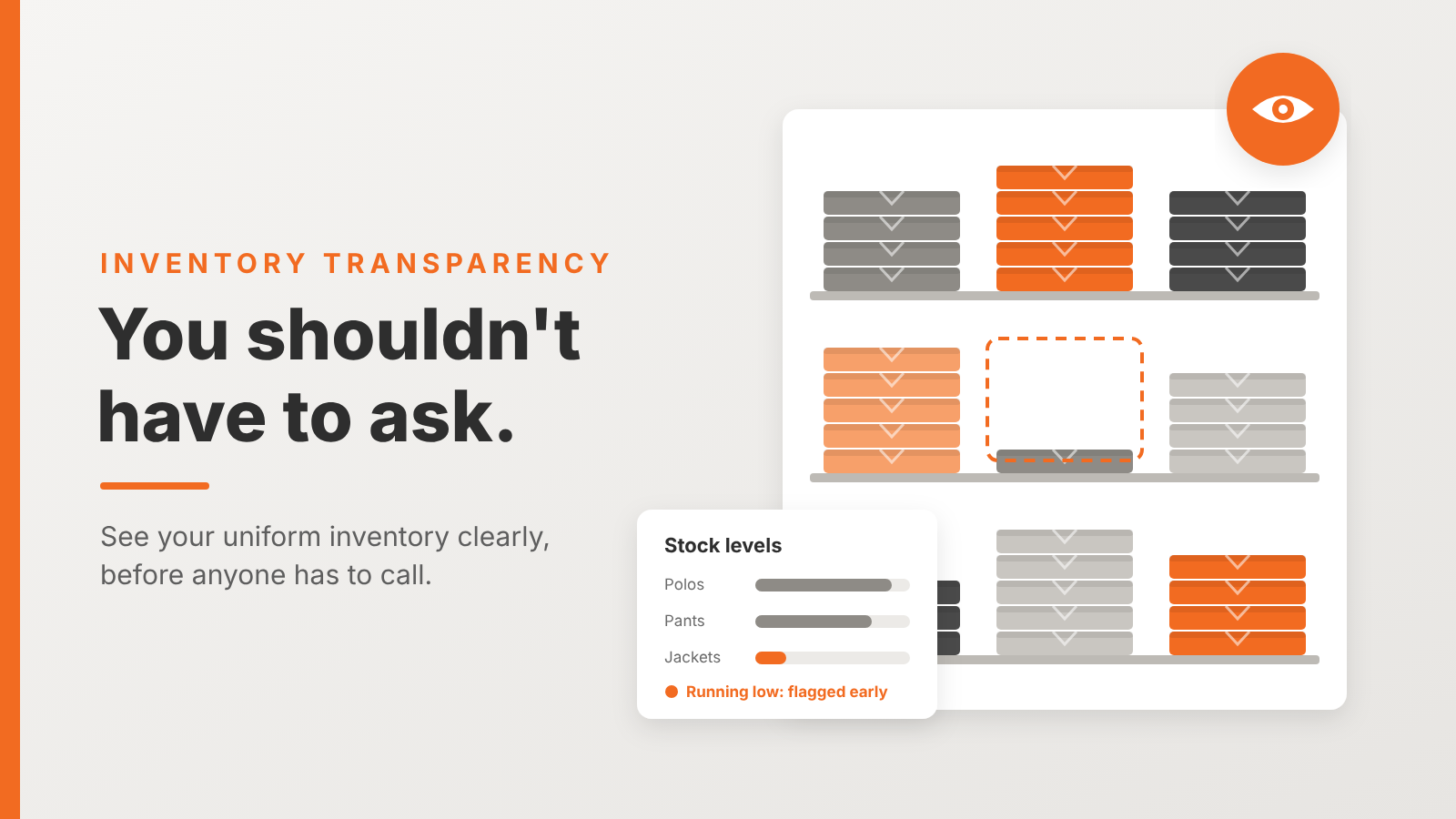
Clear visibility into stock levels. You can see what’s on hand for your program and what’s running low, without having to call and ask.
Early warning. If an item is going to run short, you hear about it first, with a realistic date and a recommended alternative.
Options, not just apologies. Because we own our factories, we can produce small quantities when needed, adjust a run, substitute a comparable item or ship what’s available so nobody starts without a uniform.
Regular inventory reviews. We walk through usage, stock levels and upcoming needs with you on a set schedule.
A real person accountable for your account. One point of contact who knows your program and answers when you call.
Employee ordering, allowance tracking and reporting tools support all of this, but the transparency comes from owning the work behind them.
Five questions to ask your uniform supplier
If you often find out about shortages after the fact, these questions will tell you a lot about your current program:
Do you own the factories that make our garments, or wait on outside factories and their minimums?
How is our inventory forecast, and how often do you review it with us?
Can we see our stock levels, and what’s running low, at any time?
When an item is going to run short, how and when do we find out?
Who is our named contact, and how quickly do they respond?
Vague answers are a warning sign. A supplier that controls its own production should be able to answer every one of these specifically.
See it before you have to ask
Shortages will never disappear from the apparel business entirely. Being in the dark about them should. When your uniform partner owns the work from design to delivery, you can see your inventory clearly, problems surface early, and your employees get dressed on time.
If you’re tired of chasing answers about your uniform inventory, talk to JWE about what a transparent program looks like.
